

Orange County Housing Report:
GLOBAL INFLUENCES ON HOUSING
A STEADY STREAM OF INTERNATIONAL TENSIONS CONTINUES TO MAKE HEADLINES, AT TIMES INFLUENCING THE HOUSING MARKET BY PUSHING MORTGAGE RATES HIGHER.
The economic term “exogenous shock” refers to an unexpected, external, unpredictable event that disrupts a system from the outside. For example, a sudden heat wave hits a kid’s lemonade stand, where demand skyrockets. The kid had nothing to do with the instant change in the weather, yet lemonade sales went through the roof. Or when a hit TV show is filmed in a small town. In the blink of an eye, hotels and vacation rentals are completely booked, and there are no more restaurant reservations available. The sleepy town quickly became a tourist destination when it was unexpectedly featured on TV. There are many examples of exogenous shocks that have had a major impact on the economy. A prime example is the U.S. COVID-19 lockdown of March 2020, six years ago. It was the largest worldwide pandemic in a century, and it touched almost every corner of the economy for years. The Iran conflict, which began on February 28, 2026, is the latest exogenous shock to hit
the U.S. and global economies. Due to the effective closure of the Strait of Hormuz, gas prices abruptly soared. According to AAA, a gallon of gas in California was $4.64 on February 28 , and today it has soared to $5.53, an increase of $0.89, or 19%. With the rapid change in prices, many are turning to COSTCO for gas, averaging $5.12 per gallon across the state, a substantial savings.
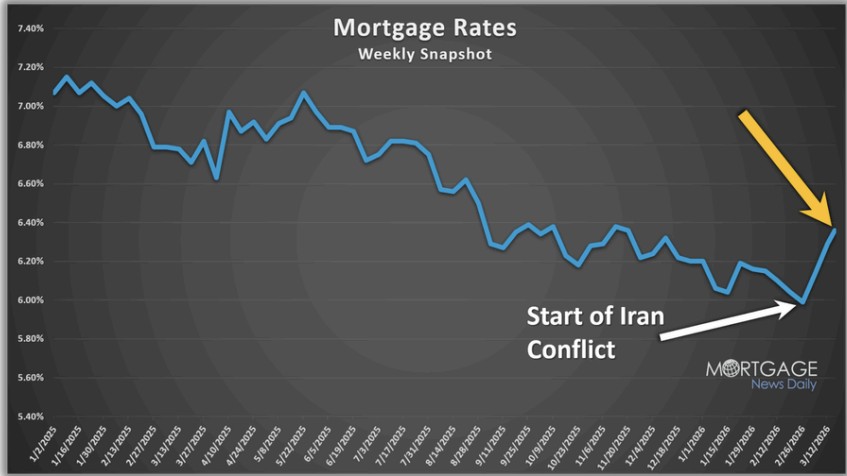
The sudden shift in gas prices has many economists and investors concerned about inflation and, ultimately, the Federal Reserve’s response to the threat to price stability. As a result, according to Mortgage News Daily, mortgage rates have climbed from 5.99% on February 27 to 6.36% today. That means that a $1 million mortgage has increased monthly from $5,989 to $6,229, up $240 per month, or $2,880 per year.
Even with the recent climb in mortgage rates, it is still below last year’s level. It was at 6.8% a year ago, and eclipsed 7% in April and in May. At 6.8%, that $1 million mortgage increases to $6,519, up $290 from today, and at 7%, it would be $6,653, up $424, or $5,088 per year. The Federal Reserve’s dual mandate is to maintain price stability and promote maximum employment. According to CPI, after rising during the second half of 2025, inflation had been slowly easing. In addition, the labor market was showing further signs of weakening. On March 6 , the February Jobs Report was released, revealing that the U.S. had lost 92,000 jobs. Without the conflict in Iran, mortgage rates would have dropped below their recent 5.99% lows to levels not seen since August 2022. Housing is about to transition to the Spring Market, the busiest time of the year for buyer activity, which typically peaks between April and May. Where will buyer demand go from here? That largely depends on mortgage rates
Excerpt from Stephen Thomas OC Housing
Check out this article next